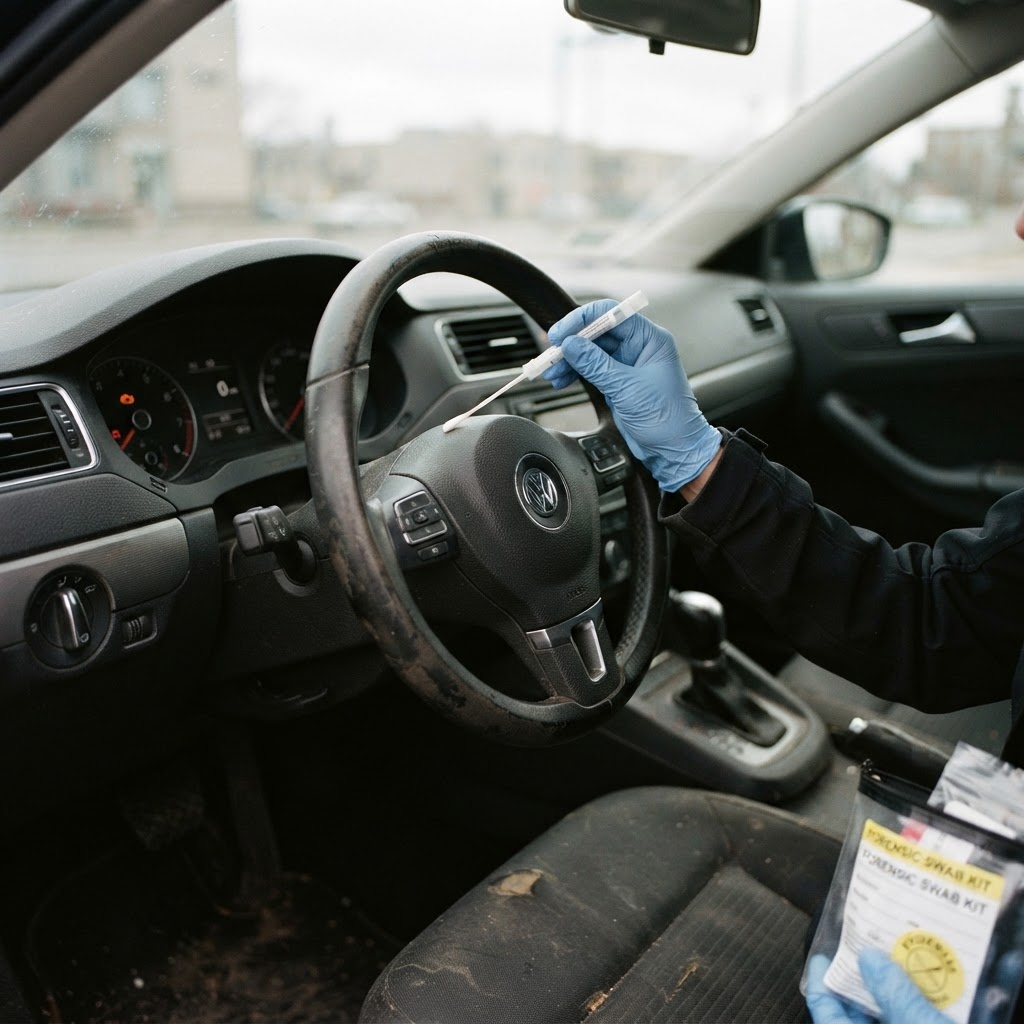
New Zealand insurers are now covering methamphetamine contamination in stolen and recovered vehicles — and EnviroCheck, New Zealand's independent property risk intelligence company, is seeing a sharp rise in enquiries from insurance assessors and business owners concerned about hidden contamination in fleet vehicles.
The development marks a shift in how vehicle meth contamination is treated by the insurance sector. What was once an unusual edge case is now being recognised as a legitimate claim category — one that carries both health and liability implications for anyone who owns, manages, or insures a vehicle.
Why Vehicles Are Higher Risk
A vehicle cabin is a confined space. When methamphetamine is smoked inside a car, ute, or van, the smoke has nowhere to disperse. Residue settles onto steering wheels, door panels, seats, headliners, and air-conditioning systems at concentrations that can exceed what you would find in a room of a house — because the volume of air is a fraction of a room's.
The residue does not break down on its own. It adheres to fabrics, plastics, and interior surfaces, and can be re-suspended through the ventilation system every time the air conditioning runs. A vehicle that has been used to smoke meth even once may test positive long after the event — which is why vehicle meth testing requires the same laboratory-grade surface sampling methodology used for properties, adapted for the confined geometry of a vehicle cabin.
The Business Fleet Risk
For business owners, the risk is both health and liability. A company vehicle used by an employee who smokes methamphetamine — or a fleet vehicle recovered after theft — becomes a workplace health and safety concern. Under New Zealand's Health and Safety at Work Act, businesses have a duty to provide a safe working environment. A contaminated company car is a contaminated workplace.
The exposure paths are real: an employee assigned a previously contaminated vehicle may inhale residue through the ventilation system or absorb it through skin contact with steering wheel and door surfaces. For businesses operating fleets — trucking and logistics, trades, delivery, agriculture, tourism, or any company with pooled vehicles — the question is not whether the risk exists, but whether it has been tested for.
Trucking fleets are a particular concern. A truck cab is a confined space where a driver may spend long hours, and contamination in that cab is a workplace exposure issue for every driver who shares the vehicle. It is also a resale issue: a used truck with methamphetamine residue in the cab is a devalued asset, and buyers are increasingly asking for evidence of a clean cab before purchase. For fleet operators, documenting that a truck is contamination-free protects both the health of the drivers and the resale value of the asset.
Insurer and Assessor Demand
EnviroCheck has been contacted directly by insurance companies and independent assessors seeking vehicle meth testing for stolen and recovered vehicles. The enquiries are coming from professionals who need defensible laboratory evidence to support or assess a contamination claim — not from vehicle owners speculating about risk. That distinction matters: it signals that the insurance sector is now treating vehicle meth contamination as a real and claimable event, not a hypothetical one.
MethShield Auto®: Vehicle Crime Prevention
EnviroCheck has developed MethShield Auto® — New Zealand's first vehicle meth deterrence system, currently patent pending. MethShield Auto is designed to help deter methamphetamine use inside vehicles by providing a visible, documented signal that a vehicle is monitored and can be tested. It is a crime-prevention and deterrent measure, not a guarantee that contamination will not occur.
For business owners and fleet managers, MethShield Auto aims to help reduce the likelihood of contamination occurring in the first place — complementing laboratory testing rather than replacing it. The system forms part of a broader vehicle risk strategy: test to establish what is on the surfaces, deter to reduce the chance of it happening again.
What to Do If You Are Concerned
If you are a business owner or fleet manager: Arrange vehicle meth testing for any vehicle in your fleet that has been stolen, recovered, or shared across drivers. Consider MethShield Auto as a deterrent layer for high-risk vehicles.
If you are an insurer or assessor: EnviroCheck provides independent, NZS 8510:2017-aligned laboratory testing for vehicle contamination claims. Contact us to discuss sampling methodology and chain-of-evidence requirements.
If you are buying a used vehicle or truck: A used car or truck meth test before purchase can identify contamination the seller may not know about — or may not disclose. For used trucks, a clean cab test protects both the buyer's investment and the health of the drivers who will use it.
Sources:
- EnviroCheck direct enquiries from insurance companies and independent assessors, September 2026.
- New Zealand media reporting on insurer coverage of methamphetamine contamination in stolen and recovered vehicles, 2026.
This press release is provided for general informational purposes only and does not constitute professional advice or a recommendation about any specific vehicle. MethShield Auto® is a deterrent system and does not guarantee that contamination will not occur.
Concerned about methamphetamine contamination in a vehicle?
Talk to EnviroCheck about independent vehicle meth testing or ask about MethShield Auto® for your fleet.
Related Vehicle Meth Testing Information
Vehicle Meth Testing
Independent laboratory testing for cars, utes, vans and commercial vehicles
MethShield Auto®
NZ's first vehicle meth deterrence system — patent pending
Vehicle Meth Testing & Insurance
Stolen and recovered vehicle contamination claims guidance
MethShield® Programme
Visible deterrence that forms part of a complete testing system
Related Articles
254kg of Methamphetamine Seized in Major Trans-Tasman Drug Crackdown
A coordinated week-long operation across Australia and New Zealand has charged more than 1,200 people and seized a quarter of a tonne of methamphetamine.
Workplace Methamphetamine Testing: Establishing Environmental Evidence
EnviroCheck's role is to establish evidence about the physical environment — not make assumptions about individuals.
Almost 40,000 Drug Utensils Seized at New Zealand Border in Seven Months
New Zealand Customs seized 39,196 drug utensils in the first seven months of 2026 — already more than all of 2025.
This article is provided for general informational purposes only and does not constitute professional advice, testing, or a recommendation about any specific vehicle. It reflects EnviroCheck's commentary on developments in vehicle meth contamination and insurance coverage.