Meth Testing WaikatoP Test, Pre-Purchase & Rental Testing
Meth testing in Hamilton & Waikato from $249 + GST. NZQA-qualified assessors, NZ Standard-compliant testing and IANZ-accredited laboratory analysis. Results typically within 24–48 hours.
Independent, NZS 8510:2017 compliant meth testing and property risk assessment across Waikato. From baseline screening to formal detailed assessments — including pre-tenancy, end-of-tenancy and change-of-tenancy meth testing for rental properties. Backed by local Q2 2026 wastewater intelligence for Waikato.
Meth testing and MethShield® baseline monitoring throughout Waikato.
Whether you need a meth test or P test in Waikato for a pre-purchase check, a pre-purchase toxicology report, property meth testing across your rental portfolio, or rental meth testing for a single tenancy, EnviroCheck covers Hamilton and wider Waikato with independent, NZS 8510:2017 compliant assessment from $249 + GST. Our assessors travel across the district — from Cambridge and Te Awamutu to Morrinsville, Matamata, Tokoroa and Raglan.
Meth testing in Waikato starts from $249 + GST. We provide methamphetamine testing for rental properties, landlords, property managers, homeowners and property buyers. See meth testing cost or request a quote. For a property-focused testing guide covering pre-tenancy and end-of-tenancy screening, see our property meth testing page. For help interpreting results, see our guide to understanding meth test results. For home buyers, pre-purchase meth testing in Waikato provides independent due diligence before settlement.
Looking for meth testing in Hamilton?
EnviroCheck provides independent property and rental meth testing throughout Hamilton and the wider Waikato region — pre-tenancy baselines, exit testing, and pre-purchase screening from $249 + GST.
Whether you need a property meth test in Waikato, a meth screen, landlord meth testing Waikato-wide, property meth testing across the region, rental property meth testing, house meth testing, or independent meth testing in Waikato, EnviroCheck provides NZS 8510:2017 compliant testing from $249 + GST. If you're searching for meth testing near me in the Waikato, our assessors cover Hamilton, Cambridge, Te Awamutu, Morrinsville, Matamata, and surrounding towns.See meth testing cost or request a quote for your Waikato property.
Waikato Methamphetamine Risk Profile
Waikato recorded 1,485 mg/day per 1,000 people in Q2 2026 — down from its four-quarter average of 1,711, a 13% decrease. Despite the decline, Waikato remains 22% above the national tested-sites average of 1,214 and continues to record among the highest per-capita methamphetamine consumption in New Zealand. The property risk environment spans urban Hamilton, regional towns, and rural communities, each with distinct risk characteristics.
Risk Rating
Waikato is classified as Very High risk based on Q2 2026 wastewater monitoring data.
Wastewater Load
1,485
mg/day per 1,000 people (Q2 2026)
1,485 mg/day per 1,000 people (Q2 2026)
Trend
Compared to the four-quarter average of 1,711 mg/day.
Latest Wastewater Data – Q2 2026
Source: New Zealand Police / PHF Science – New Zealand Drugs in Wastewater Programme, Quarter Two: April–June 2026. Figures represent the wastewater sites tested and must not be extrapolated to nearby untested communities.
Methamphetamine Trends in Waikato
Waikato is one of New Zealand's most consistently elevated methamphetamine consumption districts. The Q2 2026 wastewater data shows a decrease from the four-quarter average, but consumption remains well above the national average — a persistent baseline, not a spike. That makes pre-tenancy and pre-purchase testing particularly relevant across Hamilton, the wider Waikato towns, and the region's rural farming belt.
Waikato Q2 2026 Load
1,485
mg/day per 1,000 people
Down from a 1,711 four-quarter average.
Above National Average
+22%
vs 1,214 mg/day national avg
Waikato sits firmly in NZ's top tier of districts.
vs Four-Quarter Average
-13%
Q2 2026 vs 1,711 avg
A 13% easing — but from a persistently high base.
A persistently elevated, entrenched risk profile
Waikato's methamphetamine consumption has held well above the national average across multiple quarters. While Q2 2026 saw a 13% decrease from the four-quarter average of 1,711, the result of 1,485 mg/day per 1,000 people remains 22% above the national average — signalling entrenched use patterns rather than a transient surge. Waikato properties face persistent, not occasional, exposure risk.
Among the higher-volume districts nationally
Waikato recorded an estimated 2,470 grams of methamphetamine consumed per week in Q2 2026 — among the higher absolute volumes of any New Zealand police district. High per-capita use combined with a ~500,000-person population makes the total drug load significant across both urban and rural Waikato.
Regional towns with limited inspection infrastructure
Beyond Hamilton, Waikato's regional towns — Te Awamutu, Cambridge, Morrinsville, Matamata, Tokoroa and the King Country — have fewer local inspection service options. Properties in these areas may have had extended periods between documented assessments, making advance booking and baseline documentation especially valuable.
Rural dairy-farming properties with hard-to-verify occupancy
Waikato's extensive rural dairy-farming belt includes worker cottages, farm-staff accommodation and standalone rural dwellings where occupancy can be less visible and harder to monitor. Extended tenancy gaps or informal occupancy arrangements in these properties create history uncertainty that only testing can resolve.
Waikato's risk is persistent — don't let it go undocumented. Wastewater data shows district-level risk — only an on-site assessment confirms the condition of your specific property.
Meth Testing & Screening Services Across Waikato
EnviroCheck provides independent methamphetamine testing across the Waikato district — from baseline meth screening assessments to full NZS 8510:2017 detailed assessments. Whether you need a pre-purchase meth test before buying a Waikato property or a formal toxicology report for tribunal or insurance purposes, our structured three-level approach covers every situation.
Meth Testing Hamilton
City-wide baseline, enhanced & detailed assessments
Meth Testing NZ
National service overview & assessment levels
Pre-Purchase Meth Testing
Protect yourself before you buy
We also cover Cambridge, Te Awamutu, Morrinsville, Matamata, Tokoroa, Huntly, Ngaruawahia and surrounding rural Waikato communities. Regional towns with limited local inspection infrastructure may require advance booking — contact us to schedule an assessment.
Meth Testing Services Available
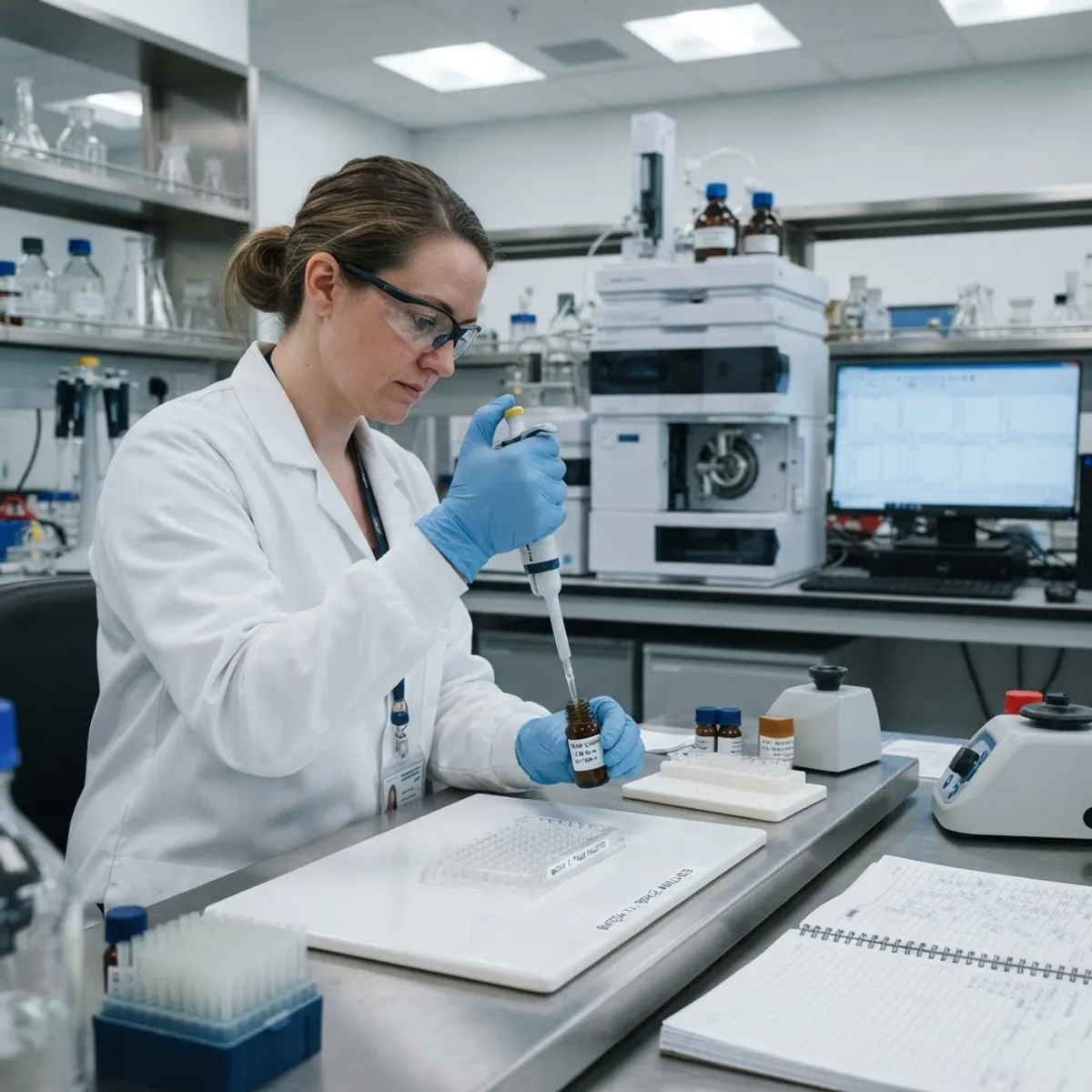
EnviroCheck provides a structured, three-level property meth testing approach across Waikato — aligned with NZS 8510:2017 and the Residential Tenancies (Managing Methamphetamine Contamination) Regulations 2026.
Baseline Screening Assessment
An affordable starting point for understanding potential contamination risk. Surface wipe samples with laboratory composite analysis — ideal for change-of-tenancy and pre-purchase checks.
Enhanced Screening
Individual laboratory analysis with location-specific results. Recommended where risk indicators exist or previous results require clarification.
Detailed Assessment (NZS 8510:2017)
Comprehensive room-by-room investigation using NIOSH Method 9111. Required for Tenancy Tribunal matters, insurance claims, and remediation scoping.
MethShield® Baseline Monitoring Programme
EnviroCheck pioneered baseline methamphetamine testing in New Zealand, commissioning the country's first surface-residue testing programme in 2011. MethShield builds on that foundation — aiming to help reduce the risk of meth contamination through visible deterrence and prevention-focused property practices.
The programme combines baseline methamphetamine testing, follow-up monitoring and visible MethShield signage to support ongoing property risk management.
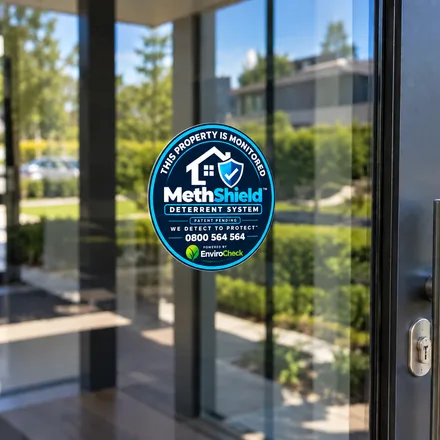
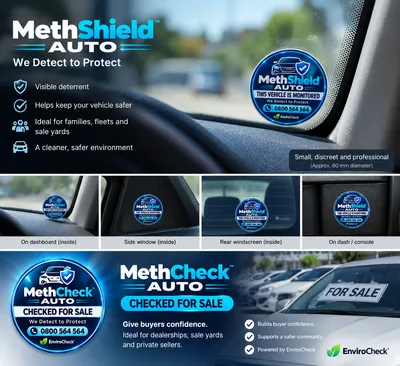
The MethShield badges identify participation in our baseline monitoring and deterrence programme — the deterrent system signage signals that this property is part of a structured testing, monitoring and risk-management programme.
Find the Right Service
Pick the situation that fits and we'll take you straight to the right EnviroCheck service or tool — no guesswork.
Manage a portfolio? Join the MethShield® Baseline Monitoring Programme.
Become a MethShield PartnerMeth Toxicology Reports in Waikato
EnviroCheck provides independent methamphetamine property testing and laboratory-based contamination reports throughout Waikato. Whether you are purchasing a house, managing a rental property, preparing for new tenants or investigating suspected methamphetamine contamination, our assessment services provide documented sampling results and professional interpretation.
Our property toxicology reporting identifies methamphetamine residue detected on sampled surfaces, with laboratory results expressed in micrograms per 100 cm² (µg/100 cm²). We provide meth testing and associated reporting throughout Waikato. For a full explanation of what a laboratory report contains and how to read one, see our guide to meth toxicology reports and how to read a meth toxicology report.
Waikato Toxicology Report FAQs
What is a meth toxicology report in Waikato?
A meth toxicology report — sometimes called a property toxicology report or methamphetamine laboratory report — is the documented laboratory result from a methamphetamine surface-residue test on a Waikato property. It records whether contamination is present, at what concentration (in µg/100 cm²), and which areas were sampled. EnviroCheck's reports are independent, NZS 8510:2017 aligned, and suitable for pre-purchase due diligence, tenancy disputes and insurance claims.
How much does a toxicology report cost in Waikato?
A meth toxicology report is included with every EnviroCheck assessment and starts from $249 + GST for a Baseline Screening Assessment in Waikato. The final cost depends on property size, the assessment level, and the number of samples analysed. Contact EnviroCheck on 0800 564 564 for a tailored quote for your Waikato property.
Meth Testing Services in Waikato
Meth Testing Across Waikato
EnviroCheck provides meth testing across the entire Waikato region for residential properties, rental properties, property managers, landlords, home buyers, homeowners, social housing providers, and rural property clients. From Hamilton city to Cambridge, Te Awamutu, Huntly, Morrinsville, Matamata, Te Aroha, Thames, Tokoroa, Putāruru, Ōtorohanga, Te Kūiti, Ngāruawāhia, Raglan, Te Kauwhata, Taupiri, Pirongia, Te Kowhai, Ōhaupō, Tirau and Ngatea, our independent assessors travel across the district. Whether you need a pre-tenancy baseline screen for a Hamilton rental, a pre-purchase meth test for a Cambridge lifestyle block, or a baseline assessment for rural worker accommodation, EnviroCheck provides NZS 8510:2017 compliant testing from $249 + GST. For Hamilton-specific guidance, see our meth testing Hamilton page.
Property Meth Testing Across Waikato
A property meth test in Waikato gives homeowners, purchasers and property owners across the region a clear, laboratory-backed picture of whether a dwelling carries methamphetamine residue. Waikato's property stock spans urban Hamilton, regional towns like Cambridge and Te Awamutu, rural communities, and coastal settlements like Raglan — each with different occupancy-history risk. Urban Hamilton's student rentals experience very high annual turnover, while rural Waikato properties may have had extended periods of variable occupancy that are difficult to verify without testing. EnviroCheck's three-level testing approach — baseline screening, enhanced screening, and NZS 8510:2017 detailed assessment — matches the level of certainty each Waikato property decision requires.
Meth Screen Waikato — Baseline Screening
A meth screen in Waikato is the practical starting point for most property owners. A baseline meth screen uses surface wipe samples analysed by an accredited laboratory to detect methamphetamine residue, with results typically available within 24–48 hours. For Waikato landlords and property managers, a meth screen before each new tenancy establishes a documented starting condition that protects against future disputes. Given Waikato's consistently elevated position in national wastewater data — 1,485 mg/day per 1,000 people in Q2 2026, 22% above the national average — a meth screen is worthwhile across all Waikato property types, from Hamilton city apartments to rural farm cottages.
Rental Property Meth Testing in Waikato
Rental property meth testing across Waikato is particularly relevant given the region's persistently elevated wastewater profile and diverse rental market. Landlords and property managers in Hamilton, Cambridge, Te Awamutu and surrounding Waikato towns face the same obligations under the Residential Tenancies (Managing Methamphetamine Contamination) Regulations 2026 as the rest of New Zealand. EnviroCheck provides pre-tenancy and end-of-tenancy meth testing for Waikato rental properties, with independent laboratory analysis that protects landlords against future disputes and supports tribunal or insurance matters if contamination is ever alleged. For Hamilton-specific rental testing, see our meth testing Hamilton page.
Meth Testing for Landlords in Waikato
Meth testing for landlords in Waikato centres on establishing a documented baseline before each new tenancy and re-testing at exit if needed. Because Waikato consistently records among the highest per-capita methamphetamine consumption nationally, landlords across the region carry real exposure if a contamination claim arises without a baseline to reference. Rural Waikato properties — including dairy-farm worker cottages and lifestyle blocks — can have extended gaps in occupancy documentation that only a baseline screen can resolve. Together, pre-tenancy and end-of-tenancy screens create a verifiable occupancy record that the Tenancy Tribunal and insurers recognise.
Pre-Purchase Meth Testing in Waikato
Pre-purchase meth testing in Waikato is strongly recommended for buyers, particularly for rural properties with extended or unclear occupancy histories, farm cottages, lifestyle blocks, or rentals in Hamilton's student market. Waikato properties may have complex tenancy histories that are not immediately visible to a buyer. Methamphetamine contamination discovered after settlement becomes the new owner's liability, and decontamination can cost tens of thousands of dollars. A pre-purchase meth screen before your conditional due-diligence period expires gives you the evidence to negotiate, walk away, or proceed with confidence. EnviroCheck's independent testing answers to you, the buyer — not to a remediation contractor.
Meth Testing Throughout the Waikato Region
EnviroCheck provides meth testing throughout the Waikato region, covering Hamilton, Cambridge, Te Awamutu, Huntly, Morrinsville, Matamata, Te Aroha, Thames, Tokoroa, Putāruru, Ōtorohanga, Te Kūiti, Ngaruawahia, Raglan, Te Kauwhata, Taupiri, Pirongia, Te Kowhai, and surrounding communities. Whether you need a property meth test in Waikato's urban centres or a baseline screen for a rural property, our independent assessors travel across the district. Regional towns with limited local inspection infrastructure may require advance booking. For Hamilton-specific guidance, see our dedicated meth testing Hamilton page; for wider Waikato wastewater risk data, see the risk profile above.
Pre-Tenancy Meth Testing in Waikato
Pre-tenancy meth testing in Waikato establishes a clear, laboratory-documented starting condition before a new tenant takes possession. For Waikato's diverse rental stock — from Hamilton's high-turnover student rentals to rural dairy-worker cottages and Cambridge lifestyle blocks — a baseline screen is the single most useful step a landlord can take to protect against a future contamination dispute. Without a baseline, a landlord cannot demonstrate that any residue found later was not already present at the start of the tenancy. With one, responsibility for any change in condition can be fairly attributed. Given Waikato's consistently elevated position in national wastewater data, pre-tenancy baseline screening is worthwhile across all Waikato rental property types. EnviroCheck's baseline screening is affordable, fast (24–48 hour laboratory turnaround), and aligned with NZS 8510:2017 methodology.
How Meth Testing Works in Waikato
Meth testing in Waikato follows a structured, three-level approach aligned with NZS 8510:2017. A baseline screening assessment uses surface wipe samples collected from key areas of the property and analysed as a laboratory composite — the most affordable and common starting point, with results typically available within 24–48 hours. Enhanced screening provides individual laboratory analysis of each sample with location-specific results, recommended where risk indicators exist or previous results require clarification. A detailed assessment (NZS 8510:2017) uses NIOSH Method 9111 for comprehensive room-by-room investigation — required for Tenancy Tribunal matters, insurance claims, and remediation scoping. An independent EnviroCheck assessor visits your Waikato property, collects samples non-destructively, and delivers a formal laboratory report. The on-site assessment typically takes 45–90 minutes depending on property size.
Booking & Pricing for Waikato Meth Testing
Booking meth testing in Waikato starts from $249 + GST for a Baseline Screening Assessment. The final cost depends on property size, location, and testing level — enhanced screening and detailed assessments cost more because they involve individual laboratory analysis. To book, call EnviroCheck on 0800 564 564 or request a callback with your property address and preferred timing. Rural Waikato properties and regional towns with limited local inspection infrastructure may require advance booking. We provide meth testing for rental properties, landlords, property managers, homeowners, and property buyers across the Waikato region. For Hamilton-specific pricing and availability, see our meth testing Hamilton page. For a detailed breakdown of testing costs, see our meth testing cost guide.
Get a Call Back About Meth Testing in Waikato
Leave your name and number — we'll call you back with pricing and availability for Waikato. No obligation.
From Testing to Protection
We don't just test after a problem occurs. EnviroCheck provides a complete property-risk journey for Waikato property owners — from professional testing to proactive deterrence and ongoing risk management.
Professional Meth Testing
Independent, NZS 8510:2017 compliant assessment of your property's contamination status.
Meth TestingEstablish a Baseline
Document the property's starting condition at the beginning of a tenancy or monitoring period.
Due Diligence CentreMethShield® Monitoring & Deterrence
Visible deterrence and ongoing monitoring, aiming to help reduce contamination risk before it occurs.
MethShield®Ongoing Property Risk Management
Regular inspections, documentation and risk awareness across your portfolio.
Risk Intelligence Centre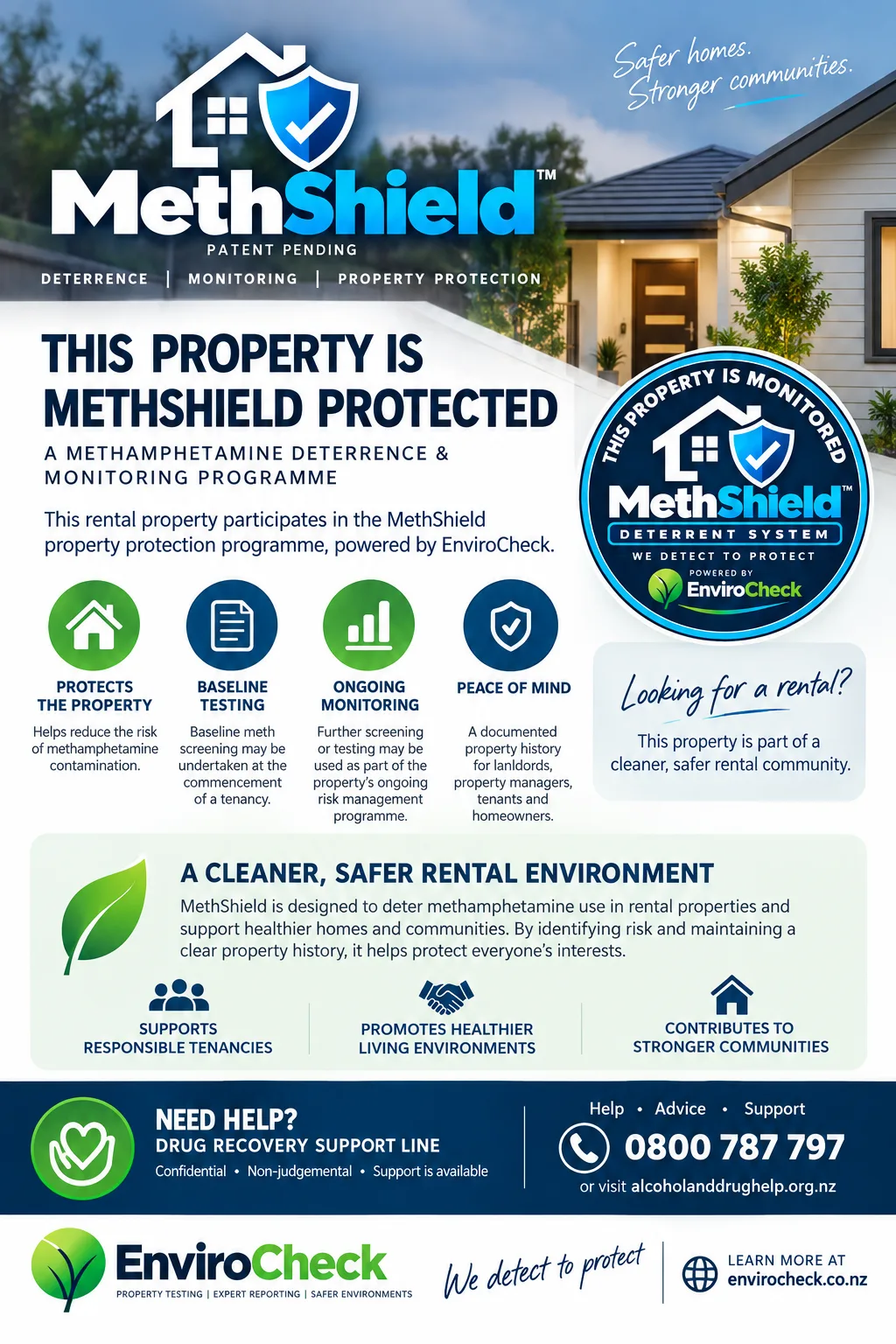
Add MethShield® protection to your Waikato property
Visible deterrence, documented property history and ongoing monitoring — the proactive layer that sits alongside professional testing.
Learn about MethShield®Free Landlord's Survival Guide
Meth risk guidance for Waikato landlords & property managers
Download the free NZ guide to rental property meth risks, warning signs, testing obligations between tenants, and property protection — with practical checklists for landlords and property managers.
Why Test in Waikato?
Landlord Considerations
Property Manager Considerations
EnviroCheck led the industry — and still does
EnviroCheck developed the baseline meth testing concept — establishing a property's documented starting condition so subsequent testing can identify changes over time.
With roots in New Zealand methamphetamine testing dating back to 2011, EnviroCheck has built a long track record of independent property assessment.
That pioneering approach now extends to MethShield® proactive deterrence and Drug Risk IQ, our snap-and-send drug risk photo tool — keeping EnviroCheck at the forefront of property risk intelligence.
DrugRisk IQ™
Suspect a property in Waikato has been used for methamphetamine manufacture or heavy use? DrugRisk IQ lets you submit photos of tell-tale signs — ventilation modifications, staining, and paraphernalia — for a confidential visual risk review by our assessors. No full address required, and photo metadata is automatically stripped to protect your privacy.
- Submit photos from your phone — no test needed to flag concerns
- Independent, conflict-free assessment by Envirocheck
REA Methamphetamine Disclosure Guidance 2026
The Real Estate Authority has updated its methamphetamine disclosure guidance for 2026, aligning with the Residential Tenancies (Managing Methamphetamine Contamination) Regulations 2026. If you're buying, selling, or renting in Waikato, understanding your disclosure obligations is essential — particularly around the 15µg/100cm² threshold above which contamination must be disclosed.
Our guidance article breaks down what changed, what the threshold means in practice, and how it affects vendors, purchasers, landlords, and property managers.
30,000+
Tested
10+ Years
In Business
24–48hr
Typical Turnaround
NZS 8510
Standards Compliant
We Detect to Protect™
Independent testing. Safer properties.
A laboratory result begins with the sample collected in the field
EnviroCheck documents sampling conditions so important context can follow the sample through laboratory analysis and reporting — preserving the distinction between surface residue and sub-paint material from the wall to the final report.
We Don't Fix Problems.
We Reveal the Truth.
Zero conflict. 100% integrity. Our independence is your guarantee of honest, unbiased results.
Test + Remediate Companies
Envirocheck
Meth Testing Questions
Straight answers to the questions property owners and managers ask most.
What Our Clients Say
Landlords, property managers, and buyers across New Zealand rely on EnviroCheck for independent, evidence-based results.
EnviroCheck gave us a clear, defensible baseline before every new tenancy. Their reports are easy to read and their team genuinely understands the property management side. We've never had a Tenancy Tribunal issue since we started using them.
Sarah
Senior Property Manager
Bay Property Group · Tauranga
As a landlord with multiple rentals across Hamilton, I needed someone independent — not a company that also does the cleanup. EnviroCheck's independence was the deciding factor. The risk calculator flagged issues I hadn't even considered.
David
Residential Landlord
Private Portfolio (6 properties) · Hamilton
We engaged EnviroCheck for a pre-purchase assessment on a property in Whangārei. The detailed assessment was thorough, the turnaround was fast, and it gave our buyer absolute confidence. I now refer all my conveyancing clients to them.
Marama
Conveyancing Solicitor
Northland Legal · Whangārei
EnviroCheck's reporting is clear, independent and exactly what we need when advising property owners. The turnaround was fast and the detail in the assessment gave our client confidence to proceed. A genuinely professional service.
Sharon
Property Risk Reviewer
Independent Assessment · Auckland
I've used EnviroCheck across a number of pre-purchase and tenancy-change assessments. Their independence from remediation work is what sets them apart — no conflict of interest, just straight results you can rely on.
David C.
Property Investor
Private Portfolio · Wellington
Meth Testing Across the Waikato Region
EnviroCheck provides independent property meth testing, pre-tenancy baseline screening and exit testing across Waikato — including Hamilton, Cambridge, Te Awamutu, Huntly, Morrinsville, Matamata, Te Aroha, Thames, Tokoroa, Putāruru, Ōtorohanga, Te Kūiti, Ngaruawahia, Raglan, Te Kauwhata, Taupiri, Pirongia, Te Kowhai, Ōhaupō, Orini, Puketaha, Tirau, Ngatea.
Meth Testing in Waikato Cities
Book meth testing in cities and towns across the Waikato district.
Meth testing Hamilton
Meth testing Cambridge
Meth testing Te Awamutu
Meth testing Huntly
Meth testing Morrinsville
Meth testing Matamata
Meth testing Raglan
Meth testing Tokoroa
Meth testing Thames
Meth testing Te Kauwhata
Meth testing Ngaruawahia
Meth testing Te Aroha
Meth testing Te Kūiti
Meth testing Ōtorohanga
Meth testing Putāruru
Meth testing Taupō
Property Meth Testing Waikato
Looking to book property meth testing across Waikato?
See our dedicated Property Meth Testing Waikato page for pre-tenancy, exit, pre-purchase and post-clean testing across Hamilton, Cambridge, Te Awamutu, Huntly and all Waikato communities. From $249 + GST.
Farm & Rural Meth Testing
Testing farm accommodation or worker housing?
One farm. Multiple houses. One documented property-risk programme. Request a farm accommodation quote for worker housing, farmhouses and rural properties across the Waikato.
MethShield Property Waikato
Testing tells you whether contamination is present today. MethShield Property goes further — a documented baseline at the start of each tenancy, visible deterrence labels throughout occupancy, and optional monitoring for Waikato rentals. A patent-pending deterrence programme by EnviroCheck.
MethShield Property does not guarantee a property will remain contamination-free.
Learn about MethShield Property WaikatoRelated Services
Key Testing Locations
Meth Testing in Other Regions
Northland
Very High risk
Central (Manawatū / Taranaki / Whanganui)
High risk
Tāmaki Makaurau (Auckland)
High risk
Eastern (Hawke's Bay / Gisborne / East Coast)
Very High risk
Bay of Plenty / Tauranga
High risk
Wellington
Elevated risk
Tasman (Nelson / Marlborough)
Elevated risk
Christchurch (Canterbury)
Elevated risk
Southland (Otago / Invercargill / Dunedin)
Moderate risk