
MethShield® Property Meth Deterrent System & Prevention
MethShield is a property meth contamination deterrent and monitoring system developed by EnviroCheck — it aims to help stop meth contamination from happening in the first place, and works as part of a testing system alongside baseline meth screening.
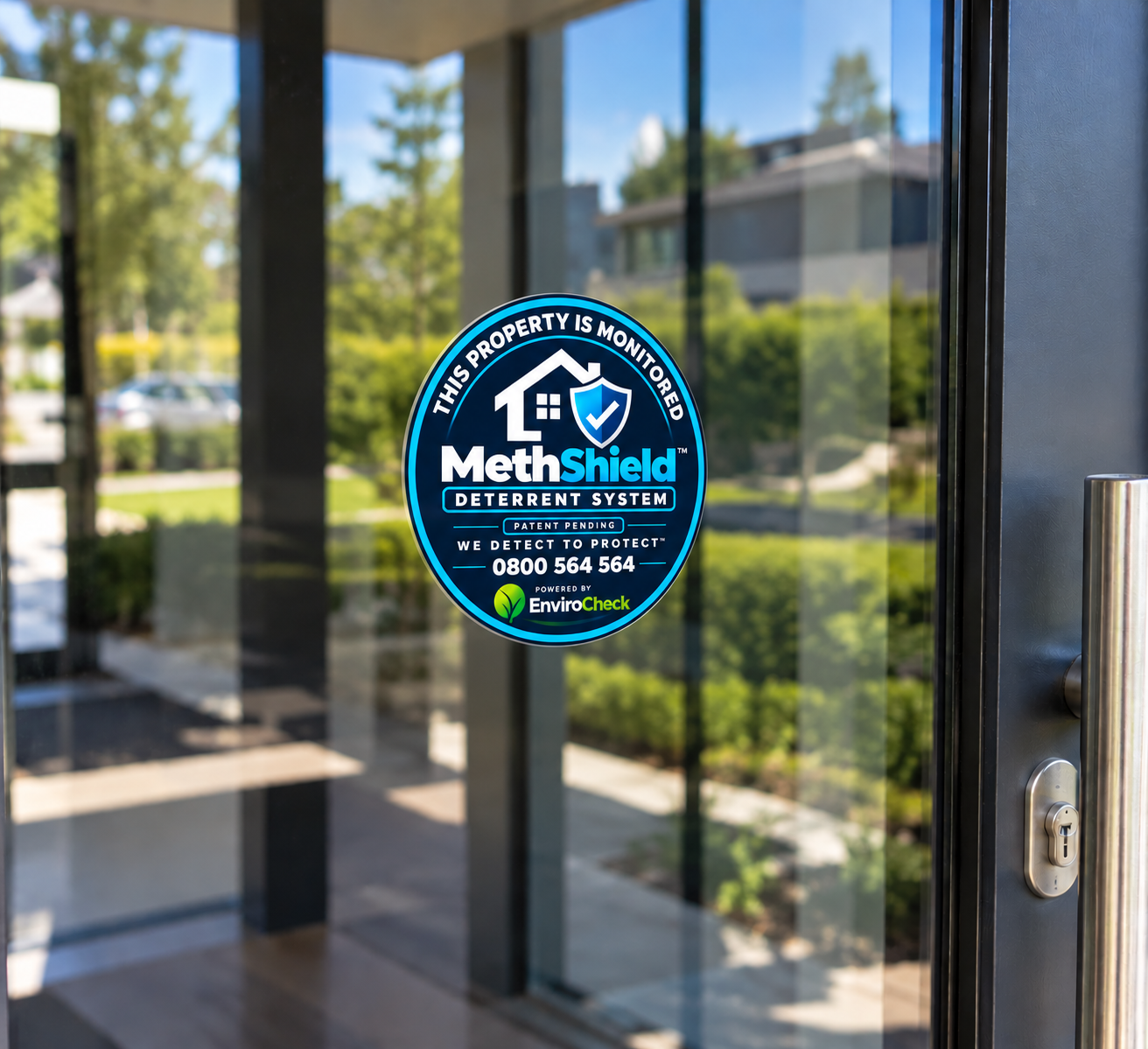
The MethShield® label can be placed inside the home only — it does not have to be on the door itself.
A Proactive Prevention System
MethShield is a property meth contamination deterrent and monitoring system developed by EnviroCheck — the pioneer of baseline methamphetamine testing in New Zealand. Having commissioned the country's first surface-residue testing programme in 2011, EnviroCheck built MethShield to help landlords, homeowners, property managers, and housing providers reduce the risk of meth contamination inside residential properties through visible deterrence and property meth monitoring.
MethShield works by placing highly visible meth deterrent stickers and warning labels at key locations within a home where contamination risks may occur. These labels remind occupants that the property promotes meth-free living and has implemented drug contamination prevention measures.
Unlike traditional approaches that focus on testing after contamination has occurred, MethShield aims to help stop contamination from happening in the first place. It is part of a complete meth monitoring system — working alongside baseline meth testing to establish a documented starting condition and then adding visible deterrence to help reduce contamination risk before it occurs. Together, testing and deterrence form a structured methamphetamine monitoring programme for your property. That baseline is only meaningful if the sample is collected correctly, which is why we also document why meth sampling technique matters.
A Simple Idea
Just as smoke alarms help protect homes from fire, MethShield helps property owners take proactive steps to reduce the risk of meth contamination.
MethShield does not guarantee a property will remain contamination-free. Instead, it provides a visible reminder that the property promotes safe, responsible use and contamination prevention practices.
Patent Pending
MethShield® is our own property meth deterrence system — designed and developed in-house by EnviroCheck. A patent is currently pending for the system.
New Zealand Patent Application No. 818430
Contamination Was Only Discovered After the Damage
After years of investigating contaminated homes throughout New Zealand, EnviroCheck — the pioneer of baseline methamphetamine testing in New Zealand — identified a common problem: most contamination was only discovered after significant damage had already occurred.
By that stage, property owners often faced costly testing, remediation, insurance issues, tenancy disputes, and loss of property value. MethShield was developed to encourage early awareness and prevention before contamination becomes a problem.
It's Not Just Tenants — Visitors Matter Too
What we've seen over the years is that visitors will come to a property and have a smoke. The concern isn't only the tenant — it can be their friends and guests undertaking that type of activity inside the home as well.
With a deterrent system in place throughout the property in selective areas, the idea is to push that activity outside if people are going to undertake it. The visible labels notify everyone entering the property that it is monitored and can be tested — not just the people on the tenancy agreement.
By placing deterrence at key locations inside the home, MethShield® helps create a situation where occupants and their visitors are made aware that contamination is taken seriously — encouraging any such activity to happen away from the property rather than inside it.
It helps to inform guests that come into the property too — making it clear to everyone who enters that the home is monitored and that contamination is taken seriously.
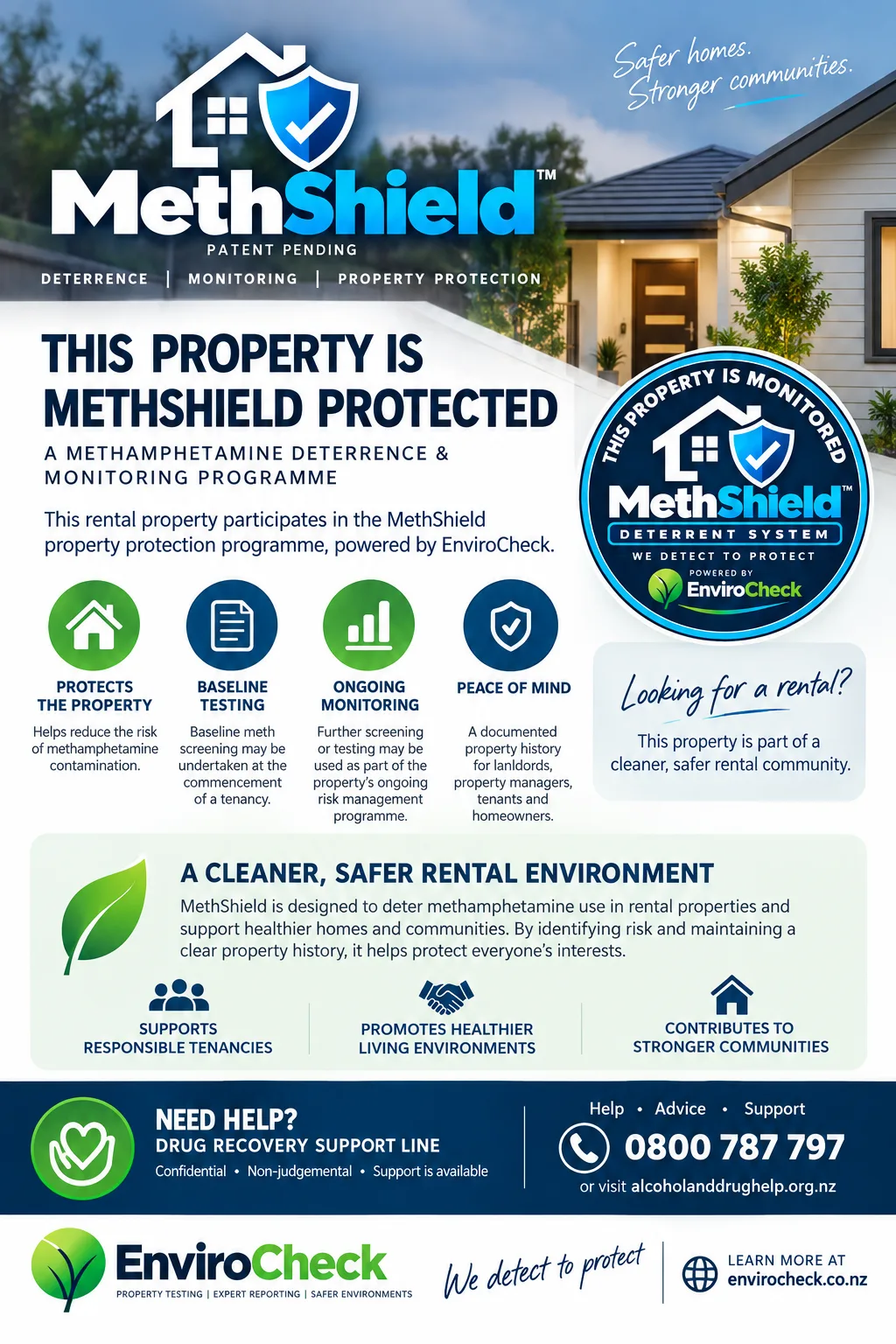
This Property Is MethShield Protected
Each MethShield-protected property displays a visible notice outlining the deterrence and monitoring programme in place. The notice reminds occupants that the property promotes meth-free living and is part of a documented property history.
The notice also connects occupants to confidential addiction support — because MethShield is designed to protect both property and people.
Deterrence & Monitoring
Visible notice that the property participates in the MethShield programme.
Documented Property History
A clear record for landlords, property managers, tenants and homeowners.
Co-Branded Notices for Partners
Property managers, landlords and accommodation providers joining the MethShield Partnership Programme can co-brand the notice with their own organisation name alongside “Powered by EnviroCheck” — signalling independent, professional backing behind your property risk management programme.
Explore the Partnership ProgrammeWhat MethShield Aims to Do
Visible Deterrence
Highly visible warning labels at key locations remind occupants that the property promotes meth-free living.
Prevention-First Approach
Unlike testing after contamination occurs, MethShield focuses on reducing risk before it becomes a problem.
Responsible Tenancy
Encourages responsible occupancy behaviour and supports property management documentation.
Addiction Support Access
Provides access to addiction support information for occupants who may need help.
Where MethShield Labels Are Installed
MethShield labels are installed at key locations within the home — areas commonly associated with higher contamination risk during property investigations.
Developed by EnviroCheck
MethShield was developed by EnviroCheck Forensic Ltd — the pioneer of baseline methamphetamine testing in New Zealand — using real-world experience gained from property assessments across the country since 2011.
MethShield aims to reduce the risk of meth contamination through visible deterrence and prevention-focused property practices.
Pioneering Baseline Meth Testing in New Zealand
EnviroCheck founder Todd Sheppard was an early pioneer of New Zealand's property methamphetamine-testing industry and developed the baseline meth testing approach as a practical way of establishing a documented starting condition for a property.
The principle is straightforward: test a property at the beginning of a tenancy or monitoring period, retain that result as the property's baseline, and use subsequent testing to identify changes in methamphetamine residue over time.
This approach provides landlords and property managers with something that testing only at the end of a tenancy cannot provide — a documented point of comparison.
From Baseline to MethShield
That early baseline concept has continued to evolve. Today, EnviroCheck's MethShield system takes the approach further by combining baseline information with visible deterrence, property monitoring and risk-based follow-up.
MethShield's patent-pending technology (NZ Patent Application No. 818430) includes the concept of a controlled sampling/reference surface that can support repeat testing and the creation of a historical contamination record.
From baseline testing to proactive deterrence and monitoring, EnviroCheck has continued to develop practical ways of helping property owners identify and manage methamphetamine contamination risk.
MethShield Works in Conjunction With Baseline Testing
MethShield is most effective when used alongside EnviroCheck's Baseline Screening Assessment. Together, they form a complete prevention and detection strategy for your property.
MethShield establishes visible deterrence and promotes meth-free living from the outset of a tenancy. Baseline testing then provides a documented, factual record of the property's condition — both before and after occupancy — giving property owners the evidence they need if contamination is ever suspected.
This makes MethShield particularly valuable as part of rental property meth testing and pre-tenancy meth testing programmes — establishing a clean baseline at the start of a tenancy and maintaining deterrence throughout occupancy. For uncertain situations, DrugRisk IQ offers a confidential photo-based risk review.
MethShield
Visible deterrence and prevention labels installed throughout the property
Baseline Screening Assessment
Documented chemical baseline establishing the property's condition at tenancy start
Why Use Both Together?
MethShield aims to help deter potential contamination from occurring during tenancy.
Baseline testing before a tenancy documents the starting condition of the property.
If contamination is suspected at any point, you have a factual baseline to compare against.
Together they support insurance eligibility, tenancy documentation, and due diligence obligations.
Meth Monitoring for Property Managers
For property managers overseeing multiple rentals, MethShield® provides a structured property manager meth programme that combines visible tenant meth deterrent labels with documented baseline testing. This drug deterrent system for rental properties creates a consistent standard of care across every property in your portfolio — signalling to occupants that contamination is taken seriously and the property is monitored.
Meth contamination monitoring through MethShield supports health and safety obligations, strengthens insurance positions, and provides documented evidence of active risk management. For property managers, this means a defensible record showing the property had contamination prevention measures in place throughout the tenancy — not just testing after the fact.
Consistent Deterrence
Visible MethShield labels across every rental in your portfolio — a uniform standard that signals active monitoring to every tenant.
Documented Baselines
Pre-tenancy baseline testing for each property creates a documented starting condition, supporting tenancy documentation and dispute resolution.
Portfolio-Level Risk Management
A structured meth monitoring programme that scales from a handful of rentals to hundreds of properties under management.
Help Protect the Ceiling Cavity
If a contamination event occurs within the occupied area of a property, an open or unsecured ceiling hatch may provide a pathway for contamination to migrate into the ceiling cavity.
This can potentially affect insulation, framing and other materials that may previously have been uncontaminated.
Once contamination reaches a ceiling cavity, remediation can become significantly more difficult and, depending on the property and extent of contamination, may cost up to $8,000 to remedy.
EnviroCheck Ceiling Cavity Locking Device
Secure the access. Help protect the cavity.
The EnviroCheck Ceiling Cavity Locking Device is a practical physical control designed to help keep ceiling access points closed and secured.
From Risk to Protection
The Risk Pathway
The Preventative Pathway
The EnviroCheck Ceiling Cavity Locking Device helps reduce the risk, helps restrict access, and may help reduce contamination spread. It does not guarantee that contamination cannot enter a ceiling cavity, but it may potentially reduce remediation costs.
Documented Installation Records
Where the EnviroCheck locking device is installed, MethShield records can include:
MethShield© Auto
The same prevention-first philosophy — now for vehicles. A small, discreet deterrent sticker applied to your windscreen that signals active monitoring.

We Detect to Protect
A Small, Discreet Professional Sticker
Approximately 60 mm in diameter, the MethShield Auto badge is applied to the inside of your vehicle's windscreen or dashboard — a visible reminder that the vehicle is monitored.
MethCheck© Auto
Give buyers confidence. Ideal for dealerships, sale yards and private sellers — a visible signal that a vehicle has been checked.
Help Is Available
MethShield provides access to addiction support information for occupants who may need help. If you or someone you know is affected by methamphetamine use, free, confidential support is available in New Zealand.
Alcohol Drug Helpline
Free, confidential advice 24/7
Te Ara Oranga
Methamphetamine harm reduction programme
Know Your Stuff NZ
Drug checking and harm reduction
Note: EnviroCheck is not a health or addiction service provider. These resources are provided for informational purposes to support access to professional help. If you are in immediate danger, call 111.
MethShield Protection Across New Zealand
MethShield sits alongside professional property meth testing in regions throughout New Zealand. Find your local meth testing page to learn about baseline screening and property risk in your area.
Northland
Meth Testing & MethShield
Central
Meth Testing & MethShield
Tāmaki Makaurau
Meth Testing & MethShield
Waikato
Meth Testing & MethShield
Eastern
Meth Testing & MethShield
Bay of Plenty / Tauranga
Meth Testing & MethShield
Wellington
Meth Testing & MethShield
Tasman
Meth Testing & MethShield
Christchurch
Meth Testing & MethShield
Southland
Meth Testing & MethShield
For Property Managers, Landlords
and Accommodation Providers
Organisations managing multiple properties can enquire about implementing the MethShield programme across their entire portfolio. Whether you manage ten properties or ten thousand, MethShield provides a structured approach to contamination risk management that scales with your operation.
Who Is This For?
Co-Branding Options
Partner organisations can display “Powered by EnviroCheck” on their MethShield signage — signalling independent, professional backing behind your property risk management programme.
Become a MethShield Partner
Enquire about rolling out the MethShield Baseline Monitoring Programme across your property portfolio. No account required — just fill in the form below and our team will be in touch.
MethShield® FAQs
What is the MethShield® meth deterrence system?
MethShield® is a property meth deterrence system developed by EnviroCheck — New Zealand's pioneer of baseline methamphetamine testing. It places highly visible warning labels at key locations inside a home to remind occupants that the property promotes meth-free living and has implemented contamination deterrence measures. Unlike testing that only detects contamination after it occurs, MethShield aims to help stop meth contamination from happening in the first place.
How does MethShield® work as a property meth prevention system?
MethShield® works by placing visible deterrence labels at higher-risk locations within a property — ceiling access hatches, heat pumps, range hoods, utility cupboards, garages and storage spaces. The labels signal that the property is monitored and can be tested. This visible deterrence is designed to reduce the likelihood of methamphetamine use inside the property. MethShield is most effective when used alongside baseline meth testing, which documents the property's starting condition at the beginning of a tenancy.
Is MethShield® suitable for landlords and rental properties?
Yes. Landlord meth protection is one of the core uses of MethShield®. Rental properties benefit from visible deterrence labels that promote responsible occupancy behaviour, combined with pre-tenancy baseline testing that documents the property's condition. Together they support tenancy documentation, insurance positions, and due diligence obligations. MethShield is suitable for long-term rentals, short-stay holiday homes, and housing provider portfolios across New Zealand.
Can MethShield® be used in holiday homes and short-stay rentals?
Yes. Holiday home meth protection and short-stay rental deterrence are growing uses of MethShield®. Properties with high guest turnover — including Airbnb and Bookabach listings — benefit from visible deterrence labels that signal the property is monitored. When paired with baseline testing between guest stays, MethShield helps holiday home owners reduce the risk of meth contamination and maintain a documented record of the property's condition.
Does MethShield® work with baseline meth testing?
Yes. MethShield® is designed to work alongside EnviroCheck's Baseline Screening Assessment. Baseline testing establishes a documented, factual record of the property's condition before occupancy, while MethShield adds visible deterrence throughout the tenancy to help reduce contamination risk. Together they form a complete prevention and detection strategy — test to establish what is on the surfaces, deter to reduce the chance of it happening again.
Is MethShield® a patented meth deterrence system?
MethShield® is a patent-pending meth deterrence system. New Zealand Patent Application No. 818430 has been filed. The system is designed and owned by EnviroCheck Forensic Ltd, the pioneer of baseline methamphetamine testing in New Zealand. It is the only property meth deterrence programme of its kind in New Zealand — competitors offer testing, but none offer a structured crime-prevention deterrent system designed specifically for residential properties.
Does MethShield® guarantee my property will stay meth-free?
No. MethShield® does not guarantee a property will remain contamination-free. It provides a visible reminder that the property promotes safe, responsible use and contamination prevention practices. The deterrent aims to reduce the likelihood of methamphetamine use inside the property, but no deterrent system can guarantee prevention. Regular baseline testing remains the only way to confirm a property's contamination status.
Where are MethShield® deterrence labels installed?
MethShield® labels are installed at key locations within the home where contamination risks are commonly identified during property investigations — ceiling access hatches, heat pumps, range hoods, utility cupboards, garage areas, storage spaces, and other higher-risk areas identified within the home. The placement is based on real-world experience from property assessments across New Zealand since 2011.
How can landlords prevent meth contamination in a rental property?
The most effective way to prevent meth contamination in a rental property is to combine visible deterrence with documented baseline testing. MethShield® works as a meth deterrent system for landlords in NZ by placing visible warning labels at higher-risk locations, signalling to occupants that the property is monitored. Pairing this with pre-tenancy baseline meth testing establishes a documented starting condition, so if contamination is later suspected, you have evidence to compare against. No deterrent can guarantee prevention, but together they form a structured risk reduction approach.
How does property meth monitoring work as part of a meth monitoring programme?
Property meth monitoring through MethShield® combines two elements: visible deterrence labels installed throughout the tenancy, and baseline meth testing that documents the property's condition at key points — typically before and after occupancy. This meth monitoring system creates a documented record showing the property has active contamination prevention measures in place. For rental properties, this meth monitoring programme supports insurance positions, tenancy documentation, and due diligence obligations.
Is MethShield® a drug deterrent system for rental properties?
Yes. MethShield® is designed as a drug deterrent system for rental properties — the visible warning labels signal to occupants that the property is monitored and can be tested. The system supports property managers and landlords who want to demonstrate active risk management. MethShield is suitable for long-term rentals, short-stay holiday homes, and housing provider portfolios, and works alongside baseline testing to create a complete prevention and detection strategy.
Are MethShield® deterrent stickers suitable for all property types?
MethShield® deterrent stickers and warning labels are suitable for most residential properties, including long-term rentals, short-stay holiday homes, and housing provider portfolios. The labels are placed at higher-risk locations identified through property assessment experience — ceiling access hatches, heat pumps, range hoods, utility cupboards, garages and storage spaces. For property managers overseeing multiple rentals, the stickers provide a consistent visible deterrent across every property in the portfolio.