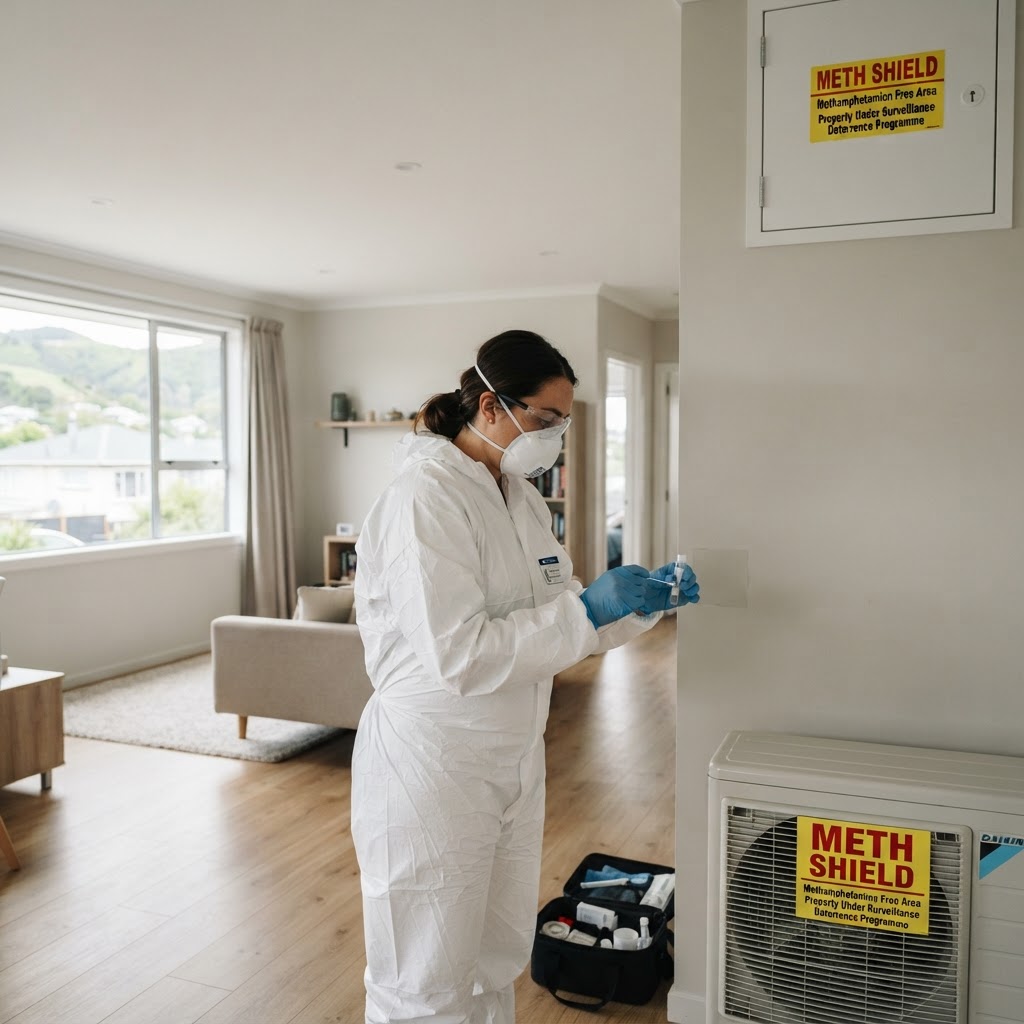
EnviroCheck — the company that pioneered baseline meth testing in New Zealand — has developed MethShield®, a visible property deterrence system designed to help stop methamphetamine contamination from happening in the first place, and to work as part of a complete testing-and-protection approach alongside baseline screening.
The launch reflects a shift in how property meth risk is managed: from testing only after contamination is suspected, toward a prevention-first model where deterrence and baseline testing work together. For landlords and property owners, that means a property can be tested to establish a clean starting point, then fitted with visible deterrence that aims to help keep it that way.
From Baseline Testing Pioneer to Deterrence
EnviroCheck was among the first in New Zealand to champion baseline meth testing — the practice of testing a property at the start of a tenancy to establish a clean reference point, so that any contamination found later can be attributed with confidence. Baseline testing changed the conversation around tenancy meth disputes by giving landlords and tenants a defensible starting position rather than a guessing game.
MethShield extends that same principle forward in time. Where baseline testing establishes what is on the surfaces today, MethShield aims to help influence what happens tomorrow — by making it clear to occupants that the property is monitored and can be tested. The two are designed to work together: test to establish, deter to protect.
How MethShield Works
MethShield is a property warning and contamination risk management system. Visible warning labels are placed at key locations throughout a property — ceiling access hatches, heat pumps, range hoods, utility cupboards, garage areas, and other higher-risk zones — signalling that the property promotes meth-free living and can be tested.
The labels are a deterrent, not a guarantee. MethShield aims to help reduce the likelihood of contamination occurring by making the risk of detection visible. It is a prevention-first layer that complements laboratory testing rather than replacing it — and it is most effective when installed after a property has been baseline tested and confirmed clean.
Why Testing and Deterrence Belong Together
Testing alone tells you what is on the surfaces at a point in time. Deterrence alone signals intent without evidence. Together, they form a complete approach: baseline testing gives you a defensible clean starting point, and MethShield aims to help keep the property in that condition across the tenancy. For landlords managing multiple properties, this combination offers something neither measure offers on its own — a documented, visible risk-management strategy rather than a reactive one.
What It Means for Landlords
For landlords, the practical implication is straightforward. A property that is baseline tested at the start of a tenancy and fitted with MethShield deterrence has both evidence and prevention in place. If a future test returns a positive result, the baseline provides a reference point. If it returns clean, MethShield aims to help keep it that way.
This is particularly relevant for rental properties and holiday homes with high tenant turnover, where the window for contamination to occur between tests is longer and the risk of undiscovered contamination is higher.
What to Do Next
If you are a landlord or property owner: Arrange baseline meth testing to establish a clean starting point, then ask about MethShield deterrence for the property.
If you are a property manager: A baseline-plus-MethShield approach across your portfolio gives you documented evidence and visible prevention for every tenancy — supporting your management obligations and reducing dispute risk.
If you are a journalist: EnviroCheck can provide background on the development of baseline meth testing in New Zealand, the MethShield deterrence system, and the shift toward prevention-first property meth risk management.
Sources:
- EnviroCheck historical records on the introduction and development of baseline meth testing in New Zealand.
- EnviroCheck MethShield® programme documentation, 2026.
This press release is provided for general informational purposes only and does not constitute professional advice or a recommendation about any specific property. MethShield® is a deterrent system and does not guarantee that contamination will not occur.
Want a tested and protected property?
Talk to EnviroCheck about baseline meth testing and MethShield® deterrence for your rental or property portfolio.
Related Meth Testing Information
MethShield® Programme
The property meth deterrence system — visible warning labels that work alongside baseline testing
Property Meth Testing
Independent laboratory testing for homeowners, landlords and property managers
Rental Property Meth Testing
Baseline, pre-tenancy and end-of-tenancy testing for tenanted properties
Meth Testing Overview
The full range of EnviroCheck meth testing services across New Zealand
Related Articles
254kg of Methamphetamine Seized in Major Trans-Tasman Drug Crackdown
A coordinated week-long operation across Australia and New Zealand has charged more than 1,200 people and seized a quarter of a tonne of methamphetamine.
EnviroCheck Publishes Technical Guide on Why Methamphetamine Sampling Technique Matters
New resource explains why the way a sample is collected determines whether a test result can be trusted.
F. Meth Campaign: A Welcome Step and a Twenty-Year Question
New Zealand's new national methamphetamine prevention campaign is a positive development — but it raises a serious historical question about why sustained prevention took two decades to arrive.
This article is provided for general informational purposes only and does not constitute professional advice, testing, or a recommendation about any specific property. It reflects EnviroCheck's commentary on property meth deterrence and the MethShield® system.